I am not sure why I've never made a Hummingbird Cake before. It's a very popular cake in recipe books from the southern U.S. There is much speculation about how the cake got its name and how it became popular in the South since bananas, cinnamon and pineapple are not native. Much of the lore regarding the name comes from the sweetness and fruitiness of the cake being sweet enough to attract a hummingbird. It seems like the cake's origin was from Jamaica (hence the tropical fruits) but the recipe proliferated after being featured in
Southern Living magazine in the 1970's.

This recipe is from
The Best of Georgia Farms cookbook, a collection of recipes from the Market Bulletin published by the Georgia Department of Agriculture. It is an oil based cake, like a carrot cake, so it is moist and tender. This Hummingbird Cake is far superior to a carrot cake (even mine, see March 28) because of the depth of flavor from the bananas. Plus, there's never anything wrong with a cake containing both pecans and cream cheese frosting. Perhaps it's called a Hummingbird Cake because it goes SO FAST.
My lack of experience with a Hummingbird Cake is even more baffling when I consider that it is my namesake cake. Not a Samantha cake, Hummingbird Cake. In Cherokee tradition, your mother's father names you, and in most respects the name is symbolic and not used on official documents like a birth certificate. My mother's father, Blaine, named me Walelu (wah-leh-lu), hummingbird, at my birth. I loved that I was named for a bird so quick and beautiful. But the best attribute of hummingbirds, I think, is their bravery. A hummingbird will fearlessly attack a much bigger bird, even an eagle, if its nest or family is in peril. I know that bravery, like my name, comes from Blaine.
My full-blooded Cherokee grandfather was born on the reservation in 1915. He was educated in a school on the reservation, run by the US government that kept children separated from their families not just by the content of the curriculum, but also by a tall fence. His mother, Luzene Sequoyah Hill, had herself been removed from her family and shipped off to the Carlisle School in Pennsylvania for her childhood education. The government removed her from her family, changed her hair, her language and her clothes to train her to be a domestic for a white family. Remembering the pain of her own loss and homesickness made her walk down the mountain every day to stand outside the fence of the reservation school to watch over her own children.
 |
| Blaine |
There is a long and proud tradition in Native America of volunteering for the U.S. armed forces. Blaine followed this tradition and a family legacy; he enlisted for the U.S. Army in 1938 and joined the 82nd Airborne paratroopers. He fought in World War II and returned home. He also fought in the Korean Conflict with the 101st Airborne and logged over 100 jumps in his career. Back home, he and another Cherokee veteran, in full uniform, would be pictured in newspapers nationwide as they were turned away from voting in the state of their birth, North Carolina. Even though indians received US citizenship and the right to vote in 1924, many states refused to allow them to vote.
 |
| Maggie and Blaine |
Blaine met my grandmother, Maggie, in Cherokee, NC when her family was there on vacation in 1945. During their courtship, my grandmother and her best friend, who was also dating a soldier, branded their beaux's initials on their thighs (at stocking-top level) using the blazing red tips of matches. At the time, in Fulton County, GA, interracial marriages were against the law. So, after being refused in Atlanta, Blaine and Maggie drove to Lawrenceville, the county seat of Gwinnett County, to be married by an agreeable judge after hours. My mother, their only child, was born the following year. As a part of Blaine's military career, their little family lived in Mainz, Germany for a time while my mother was in elementary school. Blaine and Maggie stayed together for as long as their clash of cultures and family pressures would allow. After returning from Germany, the marriage ended and Blaine moved away from Atlanta.
 |
| Blaine, Mom and Maggie |
 |
| Split oak baskets dyed with butternut or black walnut foraged by Blaine |

My mother saw Blaine only sporadically as she grew up. He would come to town to visit her and bring her gifts. He never stayed in Atlanta long.
After I was born, he would continue to make visits to town at least once a year. He lived for a time in Chicago, IL, Nashville, TN, and on the Cherokee reservation. Whenever he visited, he brought us fantastic gifts; occasionally, fancy, store-bought items, along with items he created using traditional Cherokee methods. When I was about seven years old, he brought me an umbrella; navy blue with a gold-tone, plastic handle studded with plastic cabochon "jewels." I had never seen such a fancy umbrella in all of my life and I was afraid to use it in case I ruined or lost it. It made me feel like a Victorian lady, as did the pairs of gloves he brought me on several occasions.
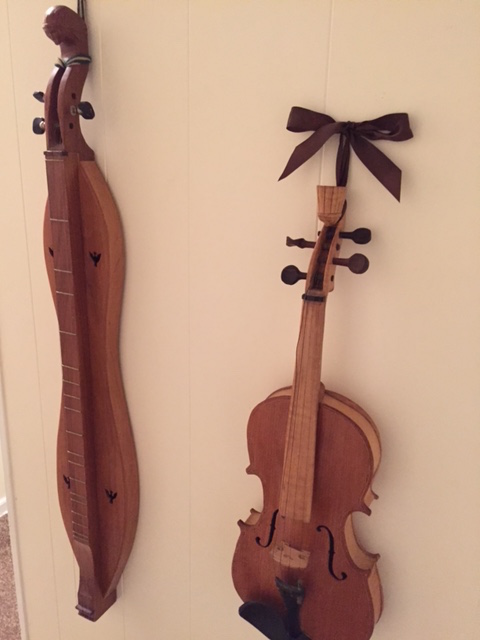
Blaine was an artist, a terrific wood carver. He made carvings of animals that he sold at craft stores in Cherokee. He made an indian-head-carved violin for my mother who played violin in high school. When I was in fourth grade, he made me a dulcimer, and I learned to play it from a
Foxfire artist in the mountains of North Georgia. When I was in the fifth grade, he visited and brought me a Cherokee blowgun he had made himself. The gun was made from straight, hollow, river cane and he had made darts complete with rabbit fur fletching. He showed me how to use the blow gun using a target painted on a cardboard box in our back yard. Blaine gave us split-white-oak baskets using oak and natural dyes (blood root, yellow root, butternut & black walnut) which he hiked into the mountains to gather. Also, he would bring us sacks of black walnuts that he had gathered in the woods, or trout he had just caught that morning in the mountains.
 |
| Some of Blaine's animals: swan, crane, wolf, buffalo and an incongruous giraffe. |

 |
| Dulcimer and violin |
Almost every time Blaine came to visit me and Mom, Maggie seemed to know somehow that he had been there to see us. For years, she would ask on the day of his visit or in the days that followed, "have you heard from Blaine?" Maggie never remarried, and I believe she always carried a torch for her ex-husband. Blaine died in 1992. Maggie hadn't asked about him in a long time by then, but shortly after he passed, she asked my mom if he had died.
I am surrounded by Blaine's tangible gifts of art and the best thing he made, my mom, the artist. Lately, I have been thinking about news stories on marriage equality,voting rights, racism, patriotism, and true bravery. I have trying to rely more on the power of instinct. And I have been thinking about my grandfather who named me after a brave and beautiful bird.
Next Saturday: Lemon Cake

 One of those friends is having her Bat Mitzvah on this Saturday in Columbia, South Carolina and has invited Colin to the big bash. Keith's parents live in Columbia, so it will be a great chance to visit them for the holidays while giving Colin a chance to party with his TIP-ster chums. Since we have been watching all of the James Bond films lately Colin is pretty fascinated with how debonair Bond can be. Colin has elected to strike a James Bond image and will be wearing a white dinner jacket ensemble to the party.
 In the 1980's, Mom and I visited my grandfather, Blaine, in Cherokee North Carolina. We stayed at one of the classic, kitschy motels on the reservation, The Pink Motel. In the coffee shop of the lobby hung an original Andy Warhol painting of Mick Jagger. What was THAT doing THERE? It is an absolute mystery. I will never forget the day that Mom and I first saw it just hanging there in a roadside tourist motel. Blaine made some inquiries to try to satisfy our curiosity and the only explanation he could divine was a story about the owner of the motel being given the painting in payment of a debt.
 Amy Vanderbilt's Sunday Night Cake is two layers of cake flavored with almond extract and sprinkled with cognac after baking. Between the layers is an almond custard and the frosting is made from almond paste and egg whites. I suspect that in the style of The Art of Cooking and Serving (see October 10, Molasses Cake), a cake on Sunday night would be for an "informal" dinner, possibly planned and prepared by the man of the house, for the purposes of entertaining drop-in guests. In Ms.Vanderbilt's recipe for Chicken a la King she even specifies such a gathering.
These time-tested recipes fit into almost any menu from brunch to midnight supper. I like them especially for Sunday-night supper or for an unplanned Sunday luncheon when I suddenly decide it would be fun to have guests. (pg. 179)


 Is this delicious but complicated and time-consuming recipe what constitutes "informal ease" in the Vanderbilt home? Perhaps it is just rude of me to ask. I suppose that should consult and etiquette guide to find out.